19 Jun 2026
How to Identify a Fake Mask? 5 Details to Look for in a CE Certificate
The real cost of a fake mask is not the money you pay for it. The real cost is the person who continues working in dust, smoke, or chemical vapors believing they are protected. Because a fake mask does not simply sell you a lack of protection; it sells something far more dangerous: the illusion of protection.
And this illusion is often well packaged. There is a CE mark on the box, the packaging looks clean, the seller says “certified product,” and the price seems attractive. The problem is this: printing two letters on a package takes only seconds; imitating the testing and supervision process that must stand behind those letters is not possible.
The good news is that you do not need a laboratory to distinguish genuine from fake. The following five checks are the kind anyone can perform at their desk before making a purchase decision. Moreover, most fake products are eliminated as early as the second step.
|
A Real-World Fact What was the common feature of millions of respiratory protective devices seized by European customs during the pandemic years? Not that they looked bad — quite the opposite, they had flawless packaging. What exposed the fake product was not the quality of the box, but inconsistencies in the documents: “certificates” issued by unauthorized bodies, non-existent numbers, and model names that did not match the product. In other words, the clues you are looking for are not visible defects; they are the details on paper. |
1. What Does the 4-Digit Number Next to the CE Mark on a Mask Mean?
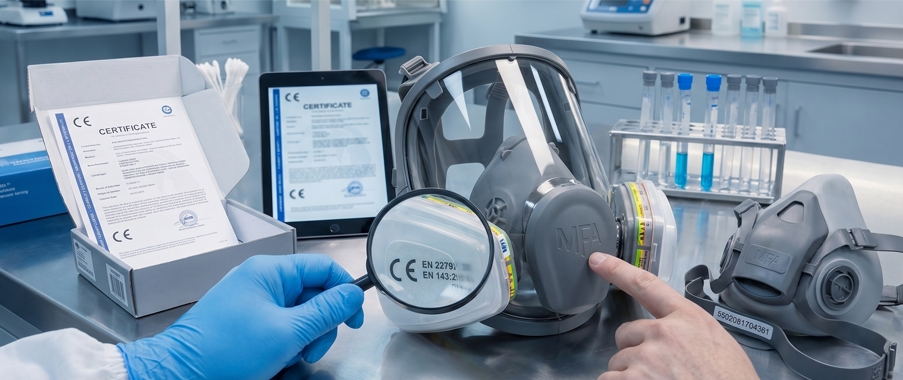
Respiratory protective masks fall under Category III, the highest risk group in PPE legislation. For products in this category, the CE mark alone is not sufficient; it must be accompanied by the four-digit identification number of the notified body that continuously supervises production. For example, “CE 2797”.
If you see a bare “CE” without a number on an FFP2 or FFP3 mask or its packaging, there are two possibilities: either the product has never been certified, or the marking does not comply with the legislation. In both cases, the result is the same — that product cannot promise you protection.
2. CE Certificate Verification: How to Use the NANDO Database?
The four-digit number is a claim; verifying it takes two minutes. The European Commission’s publicly accessible NANDO database shows the complete list of notified bodies and the scope of authorization for each one.
Two things must be checked here. First, does the number actually belong to a registered body? Second, and this is where counterfeiting often hides: does that body’s scope of authorization include the (EU) 2016/425 PPE Regulation and respiratory protective equipment? A significant portion of the fake documents circulated during the pandemic carried real notified body numbers; however, those bodies were not authorized to test masks. The existence of the number is not enough; the scope must also match.
Since the PPE Regulation in Turkey is harmonized with the same European regulation, this verification is equally valid for products in the domestic market.
3. How to Identify a Fake CE Certificate? The Difference Between a Test Report and a Certificate
When you ask the seller for a “CE certificate,” the title of the document you receive says a lot. The document you should be looking for is the EU Type-Examination Certificate.
Documents titled “Test Report,” “Certificate of Compliance,” or “Attestation” — especially if issued by laboratories that do not have notified body status — do not replace CE certification. This title game is one of the most common methods used in the fake product market.
A genuine certificate clearly shows the following: the name and number of the notified body issuing the document, the referenced standard for FFP masks (EN 149:2001+A1:2009), the manufacturer’s name, and the certified model name. It is critical that the model name matches the product in your hand exactly; differences dismissed as “another model from the same factory” mean that the certificate does not cover that product.
In addition, every manufacturer must provide an EU Declaration of Conformity upon request or provide an access address for this declaration in the user manual. The answer “we cannot share the declaration” is an answer in itself.
4. What Should Be Written on a Genuine FFP2 Mask?
The EN 149 standard requires the marking to be present not only on the box but also on the mask itself. You should see the following on the product:
- Manufacturer name or brand
- Model name
- Standard and class: such as EN 149:2001+A1:2009 FFP2
- NR (single shift) or R (reusable) marking
- CE mark + four-digit notified body number
The most common inconsistency is this: the box says “FFP2,” while the mask itself says GB2626 / KN95. KN95 is China’s national standard; it may be legitimate in its own context, but it is not an FFP2 certified under EN 149 and cannot carry the CE mark. When the box and the product speak different languages, that is the alarm bell itself.
5. Hunting for Inconsistencies: Small Details, Big Clues
The final check is not a single item but rather a perspective: details that are effortless for a legitimate manufacturer are costs for counterfeiters and are often skipped.
- Turkish user manual: It is mandatory under PPE legislation. If it is missing, the product already fails to meet the conditions for being placed on the market.
- Lot number and production/expiry date: These are the minimum requirements for traceability. A product without a date is a product without a history.
- Spelling and typesetting errors: Errors such as “Protectiv” or “Filtering Haf Mask” instead of the correct “Filtering Half Mask” may look funny, but they are serious indicators.
- Unrealistic price: A Category III product priced significantly below the market average asks the first question itself: where is the saving coming from?
Bonus: Is the “China Export” Mark Real or an Urban Legend?
Short answer: there is no officially defined “China Export” mark; this story is an urban legend. The claim that “if the CE letters are close together, it is not the European CE” has even reached the agenda of the European Parliament, but it is not based on any legislation.
So what do narrowly spaced or poorly proportioned CE marks mean? Usually one of two things: careless printing or a manufacturer using the mark without any supporting documentation. Incorrect geometry should raise suspicion; however, narrow spacing alone is not proof of a fake, nor is a perfectly proportioned CE mark a guarantee of authenticity. Counterfeiters have learned how to draw logos; they have not yet learned how to fake numbers properly.
Therefore, instead of measuring letters with a ruler, the correct action is clear: verify the four-digit number in NANDO. This two-minute check speaks more clearly than any typographic analysis.
60-Second Control Table
| Check | On a Genuine Product | On a Suspicious Product |
|---|---|---|
| CE mark | CE + four-digit number | Bare CE without number |
| NANDO verification | Body registered, scope includes PPE/respiratory protection | No number or scope does not match |
| Document title | EU Type-Examination Certificate | “Test Report”, “Attestation” |
| Marking on the mask | EN 149 + class + NR/R + manufacturer | Blank surface or KN95/GB2626 |
| Manual and traceability | Turkish manual, lot, date | No manual, no date |
A product that passes verification is only half the job; the other half is choosing the right mask type and filter class for your environment. For this, you can review our Gas Mask Selection Guide.
Conclusion: Those Who Read the Documents Cannot Be Deceived
A fake mask is caught not by its appearance but by its documents. The four-digit number, NANDO scope, certificate name, product marking, and small inconsistencies: these five details are simply a five-minute habit added to the purchasing process. What those five minutes protect is not a budget item, but the health of the person who puts that mask on every morning.
Every respiratory protective product manufactured by MFA Maske is certified under the supervision of a notified body; our certificates and declarations of conformity are shared with every customer who requests them. Because verifiability is not a part of quality, but its prerequisite. You can review certified MFA Mask FFP2 and FFP3 solutions here.
|
Have doubts about verifying your document? Get free support from the MFA Mask technical team → www.mfamask.com/en/contact |
|
Technical Consulting & Quotation www.mfamask.com │ +90 372 253 40 30 — Specify your industry and area of use; we will quickly recommend the most suitable certified respiratory protection solution for you. |
Similar Content
-
 How to Identify a Fake Mask? 5 Details to Look for in a CE Certificate
 -
 Gas Mask Selection Guide
 -
 How to Choose a Gas Mask Filter?
 -
 Why Does Your Mask Become Ineffective?
 -
 Invisible Danger: Why Do All Mask Standards Say "0.3 Micron"?
 -
 Mask Certifications Guide: Who Are You Entrusting Your Breath To?
 -
 Special Respiratory Masks for Chemical Environments
 -
 How Are Masks Cleaned and Maintained?
 -
 When Should the Filter Replacement Period Be for Masks?
 -
 In Which Sectors Are Respiratory Protective Equipment Used?